Search Results for "Modular aggregator for DEX-based margin"
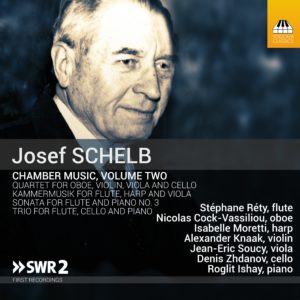
Josef Schelb: Chamber Music, Volume Two
The Karlsruhe-based Josef Schelb (1894–1977) is one of the better-kept secrets of twentieth-century German music. His output was substantial: he lost most of his early music in a bombing raid in 1942, but – as if to make up for lost time – wrote some 150 more works after that. In the four chamber works recorded here Schelb’s contrapuntal mastery is given a bucolic twist under the influence of French Impressionism, the two traditions combining to invest these pieces with a freewheeling energy and downright sense of fun.
Stéphane Réty, flute (Tracks 1-9)
Nicolas Cock-Vassiliou, oboe (Tracks 10–12)
Isabelle Moretti, harp (Tracks 1–3)
Alexander Knaak, violin (Tracks 10–12)
Jean-Eric Soucy, viola (Tracks 1–3, 10–12)
Denis Zhdanov, cello (Tracks 7–12)
Roglit Ishay, piano (Tracks 4–9)
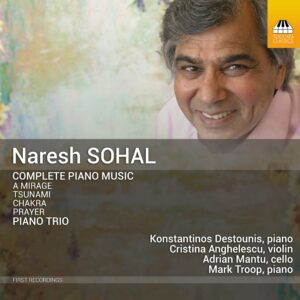
Naresh Sohal: Complete Piano Music
The British-based Naresh Sohal, born in Punjab in 1939, was the first person of Indian origin to make his mark as a composer of western classical music, writing works that displayed an unusual kind of fusion – but not stylistic: his compositions often use the language of western modernism to explore the ideas of Hindu philosophy. The handful of piano pieces that he wrote between 1974 and his death in 2018 use musical analogies to address issues of perception, even existence itself, in a language that employs Xenakis-like extremes of dynamics and virtuosity, of clarity and density and of energy and calm.
Konstantinos Destounis, piano (Tracks 1–5)
Cristina Anghelescu, violin (Track 6)
Adrian Mantu, cello (Track 6)
Mark Troop, piano (Track 6)
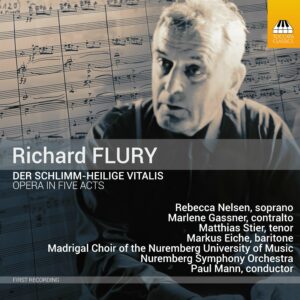
Richard Flury: Der schlimm-heilige Vitalis, Opera in Five Acts
Der schlimm-heilige Vitalis (which can be translated roughly as ‘Lustful Brother Vitalis‘) was the last of the four operas by the Swiss composer Richard Flury (1896–1967). It was premiered in 1963, the year after its completion, and then remained unheard until this recording. The plot, based on a novella by Flury’s fellow Swiss, Gottfried Keller, sets jolly village life against religious intolerance and sexual politics in an unsettling blend of the sentimental and the cynical – although love, of course, triumphs in the end. Flury’s late-Romantic music redeems the libretto with a steady flow of memorable melodies, engaging solo and choral numbers, and colourful orchestration – and with a sense of fun never far from the surface.
Rebecca Nelsen, soprano
Marlene Gassner, contralto
Matthias Stier, tenor
Markus Eiche, baritone
Madrigal Choir of the Nuremberg University of Music
Alfons Brandl, chorus-master
Nuremberg Symphony Orchestra
Paul Mann, conductor
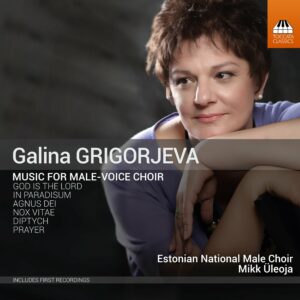
Galina Grigorjeva: Music for Male-Voice Choir
The choral music of Galina Grigorjeva – born in Simferopol in Ukraine in 1962 and based in Tallinn, in Estonia, since 1994 – is deeply rooted in the traditions of the Orthodox Church and in ancient Russian and Slavonic folklore. Although clearly by a contemporary composer, her works have a timeless, even hypnotic, quality that seems to reach back through the ages. She has been working with the Estonian National Male Choir – one of the finest in a country full of choirs – for some years now, and some of the works here were composed or arranged specifically for this recording.
Theodor Sink, cello (8, 9)
Aleksandr Mihhailov, bass (3)
Aleksander Arder, tenor (7)
Margus Vellmann, tenor (7, 9)
Grigori Rutškin, tenor (9)
Estonian National Male Choir
Mikk Üleoja, conductor
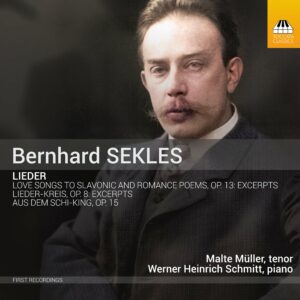
Bernhard Sekles: Lieder – Aus dem Schi-King and other Songs
Bernhard Sekles (1872–1934) was one of the leading figures in German music in the first decades of the twentieth century, prominent as composer, educator and administrator. In 1928, as director of the Hoch Conservatorium in Frankfurt, he established the first academic programme in jazz studies, an act of courage and conviction that unleashed furious attacks from the Nazi press. His own late-Romantic music, banned during the Third Reich, has been virtually forgotten, although he composed in all major genres, including opera, orchestral works and chamber music. This first-ever album of his Lieder includes a major song-cycle, the freewheeling Aus dem Schi-King, based on ancient Chinese poetry in adaptations by Friedrich Rückert, its moods ranging from the heroic to the comic.
Malte Müller, tenor
Werner Heinrich Schmitt, piano
Mit Deutschem Kommentar
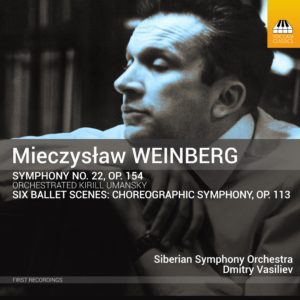
Mieczysław Weinberg: Orchestral Music, Volume Two
In the twenty years since his death the star of the Polish-born Moscow-based Mieczysław Weinberg (1919–96) has risen rapidly: his music – a highly individual amalgam of the Jewish idioms of his youth and the style of his mentor and friend Dmitry Shostakovich – is now seen as one of the most distinctive contributions to twentieth-century music. This further instalment in the Toccata Classics examination of his output couples a mature dance-based score – not performed before this recording – with his last symphony, orchestrated after his death by the composer Kirill Umansky.
Siberian Symphony Orchestra
Dmitry Vasiliev
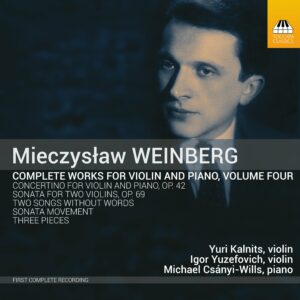
Mieczysław Weinberg: Complete Works for Violin and Piano, Volume Four
In the past twenty years the Polish-born, Moscow-based Mieczysław Weinberg (1919–96) has been recognised as one of the major voices in twentieth-century music, equivalent in stature to his close friend Dmitry Shostakovich. This fourth and final volume of his music for solo violin, violin and piano and two violins completes the only survey to take all of these works into account. It presents music ranging from a startingly assured early score by the teenage Weinberg to works in which his personality is fully established and instantly recognisable.
Yuri Kalnits, violin
Igor Yuzefovich, violin (10–12)
Michael Csányi-Wills, piano (1–9)
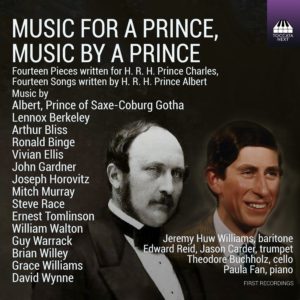
Music for a Prince, Music by a Prince: Fourteen Pieces written for H. R. H. Prince Charles, Fourteen Songs written by H. R. H. Prince Albert
This unusual recording brings princely offerings of two different kinds. In 1970 Prince Charles – who had studied cello and trumpet – was presented with a leather-bound volume containing pieces written for his entertainment by the composers on the council of the Performing Right Society. These fourteen bonnes bouches are complemented by fourteen German Lieder written by Prince Charles’ great-great-great-grandfather, Prince Albert, the Prince Consort, whose style owed something to that of his good friend, Felix Mendelssohn.
Jeremy Huw Williams, baritone (Tracks 15, 18–31)
Theodore Buchholz, cello (Tracks 1, 2, 4, 6-9, 11-14, 17)
Edward Reid, trumpet (Tracks 3, 4, 5, 8, 10, 11, 14)
Jason Carder, trumpet (Track 16)
Paula Fan, piano (Tracks 1-7, 10, 12, 14-31)
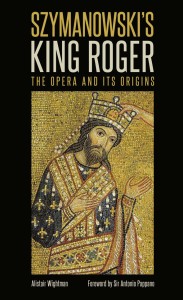
Szymanowski’s King Roger: The Opera and its Origins
Foreword by Antonio Pappano
Extent: 171 pages
Size: 24.1 x 16.4 cm
Extent: 171 pages
Composition: Royal octavo
Illustrations: 26
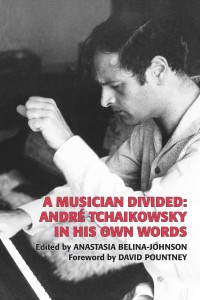
A Musician Divided: André Tchaikowsky in his Own Words
Edited by Anastasia Belina-Johnson
Foreword by David Pountney
Extant: 434
Composition: Royal octavo ~ Recordings of André Tchaikowsky's Music ~ André Tchaikowsky's Recordings ~ Index of Tchaikowsky's Music ~ General Index ~ CD of André Tchaikowsky in recital
Illustrations: 72
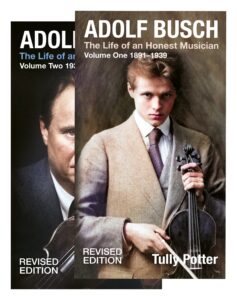
Adolf Busch: The Life of an Honest Musician – Two Volume Revised Edition Set
Volume 1: 1891–1939
Volume 2: 1939–1952; Appendices 1–12
Includes two CDs: Busch the Performer; Busch the Composer
Extent: 1432 pages
Composition: Royal octavo, 2 vols of 702 & 730 pp.
255 b/w illus.
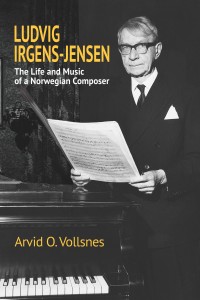
Ludvig Irgens-Jensen: The Life and Music of a Norwegian Composer
Extent: 368 pages
Composition: Royal octavo ~ Illustrations ~ LoW ~ Irgens-Jensen as Poet ~ Bibliography ~ Discography ~ Index of Irgens-Jensen's Music ~ General Index ~ Sampler CD of Irgens-Jensen’s Music
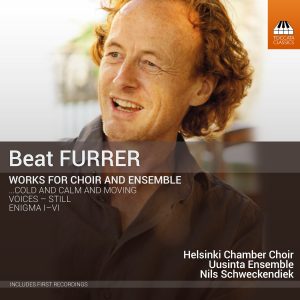
Beat Furrer: Works for Choir and Ensemble
The music of Beat Furrer, Swiss-born (in 1954) and Vienna-based, has long attracted attention for its subtle exploration of the possibilities of the human voice. This first recording of his enigmas, a cycle of six a cappella settings of Leonardo (he has since added a seventh) demonstrates its striking emotional range, from rich, almost Romantic tonal warmth to dramatic avant-garde expressionism. It is complemented by two works which underline Furrer’s fondness for exploring sonority, timbre and texture.
Helsinki Chamber Choir
Uusinta Ensemble
Nils Schweckendiek
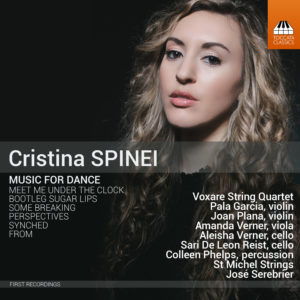
Cristina Spinei: Music for Dance
The Nashville-based Cristina Spinei (born in Connecticut in 1984) writes music which pulses with the rhythmic energy of the American minimalist tradition – ‘pulling a lot out of only a little material’, as one reviewer put it. Small wonder, then, that she is much in demand with choreographers, and this album presents music written for dance: four string quartets, a duo for cello and percussion and a work for string orchestra – all of them gently mesmeric, like some kind of unhurried ritual.
Voxare String Quartet
Pala Garcia and Joan Plana, violins
Amanda Verner, viola
Aleisha Verner, cello
Sari De Leon Reist, cello
Colleen Phelps, percussion
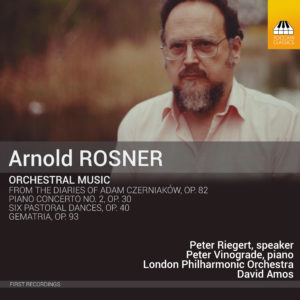
Arnold Rosner: Orchestral Music
The musical language of the New York-based Arnold Rosner (1945–2013) clothes the modal harmony and rhythm of pre-Baroque polyphony in rich Romantic colours, producing a style that is instantly recognisable and immediately appealing. The piano concerto which opens this album reveals that his personality was present from the start: although it was written before he had any formal training in composition, its confidence and individuality are striking. The other works here show the range of Rosner’s music, from his fondness for Elizabethan dance and his exploration of symphonic minimalism to an identification with his Jewish roots, in a harrowing setting for speaker and orchestra of extracts from the diary of the leader of the Warsaw Ghetto.
Peter Vinograde, piano
Peter Riegert, speaker
London Philharmonic Orchestra
David Amos, conductor
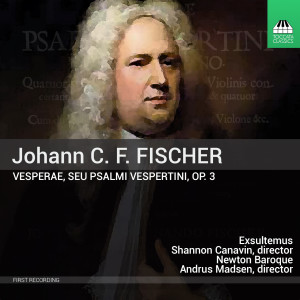
Johann Caspar Ferdinand Fischer: Vesperae, Op. 3
In his day Johann Caspar Ferdinand Fischer (1656–1746) was renowned as one of the major musicians in southern Germany, especially for his distinctly French keyboard music. His vocal music, by contrast, which has been far less thoroughly explored, looked to Italy for its models, as his captivating 1701 setting of the Vespers reveals. In keeping with the practice of the time, this first recording of Fischer’s Vespers includes music from elsewhere in his output, as well as two sonatas by the Munich-based Johann Christoph Pez (1664–1716).
Exsultemus
Shannon Canavin, director
Newton Baroque
Andrew Madsen, director, organ